


If you’re planning to invest in Salesforce consulting services, one of the first questions you’re likely to ask is simple: How much will it actually cost?
The difficult part is that there is no single Salesforce consulting price. A business looking for a two-week Salesforce health check will have a completely different budget from an enterprise planning a multi-cloud implementation, data migration, integrations, automation, and Agentforce rollout. In 2026, public market benchmarks put Salesforce consulting rates across a broad range, with experienced consultants and boutique firms commonly charging roughly $125–$300+ per hour, while specialized architects and complex transformation projects can command significantly higher rates.
The total cost also depends on where your consulting partner is located, the Salesforce products involved, project complexity, integrations, data quality, customization requirements, and whether you choose hourly, fixed-price, or ongoing consulting.
This guide breaks down Salesforce consulting costs in 2026, the factors that influence pricing, typical project ranges, regional differences, and how businesses can evaluate a quote without simply choosing the cheapest option.
Table of Contents
What Are Salesforce Consulting Services?
Salesforce consulting services cover the strategic and technical expertise businesses need to plan, configure, optimize, integrate, migrate, and scale their Salesforce environment. A consultant may begin with business-process discovery and Salesforce architecture planning, then move into configuration, automation, data migration, integrations, testing, training and post-launch optimization.
Salesforce itself describes consulting partners as firms that employ certified consultants who help organizations understand their requirements, design and build their Salesforce organization, test it, and prepare it for rollout.
That means consulting is much broader than simply hiring someone to change a field or create a report. A good consultant looks at the bigger picture: How should Salesforce support the way your business actually operates? That distinction matters when you’re calculating cost because strategic consulting, architecture, implementation, development, and managed support may all be priced differently.
How Much Does Salesforce Consulting Cost in 2026?
For 2026 budgeting purposes, publicly available market benchmarks show experienced Salesforce consulting commonly falling around $125–$300 per hour, while complex specialist or enterprise consulting can exceed $300 per hour. Some market research also shows substantially lower rates in India and other offshore delivery markets.
A recent 2026 market benchmark reports India-based Salesforce consulting companies commonly listed around $25–$49 per hour, while U.S. companies are frequently listed in higher pricing bands. GoodFirms’ August 2026 research of Salesforce consultants in India reported a $37/hour median hourly rate across its reviewed firms.
These numbers should not be interpreted as a universal price list. A senior Salesforce architect working on a complex enterprise architecture can cost considerably more than a consultant handling basic configuration. Similarly, an offshore development team may have a lower hourly rate but require more project-management coordination.
| Consulting Model | Approximate 2026 Market Range |
| Independent consultant | $80–$200+/hour |
| Boutique consulting firm | $125–$300+/hour |
| Senior consultant/architect | $200–$400+/hour |
| Specialized enterprise consulting | $300+/hour |
| India-based consulting firms | Often $25–$75+/hour |
| Focused consulting project | Several thousand dollars |
| Complex enterprise transformation | $100,000+ |
These are market benchmarks, not official Salesforce prices, and actual quotes depend heavily on project scope.
Salesforce Consulting Cost by Project Type: You Should Know About
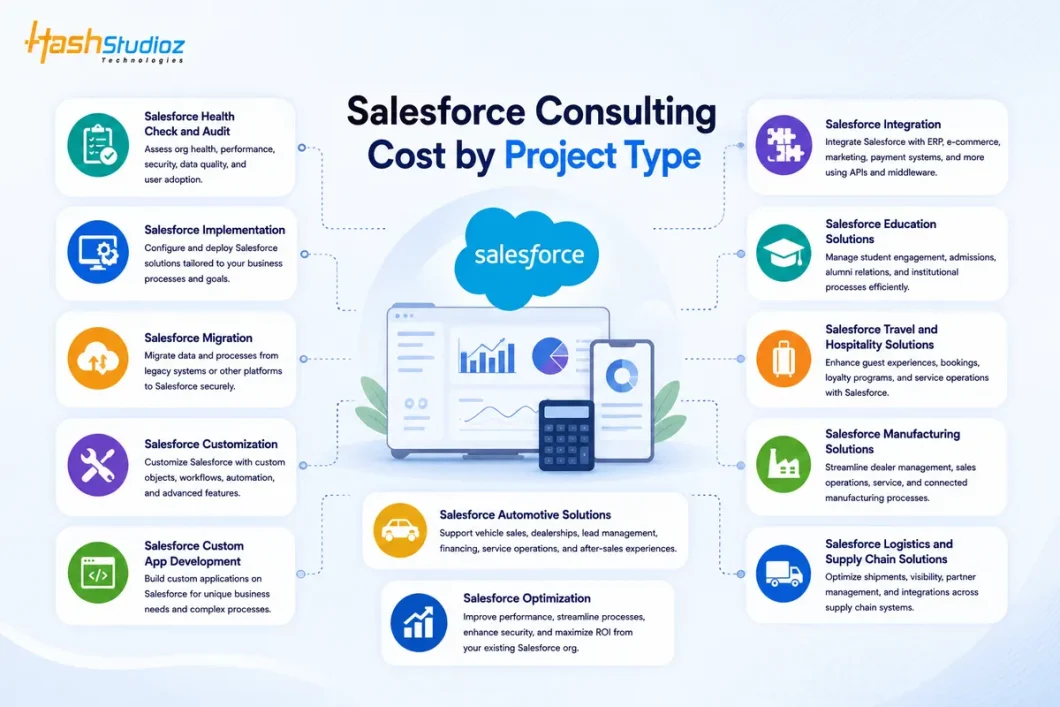
Here We have mentioned 12 Salesforce Project Types :
1. Salesforce Health Check and Audit
A Salesforce health check or audit evaluates the overall condition of your Salesforce org, including configuration, automation, data quality, security, integrations, performance, and user adoption. It is often suitable for businesses experiencing slow performance, increasing technical debt, low user adoption, or inefficient workflows.
2. Salesforce Implementation
Salesforce implementation projects involve configuring and deploying Salesforce according to an organization’s sales, service, marketing, commerce, or operational requirements. Costs depend on the Salesforce products being implemented, the number of users, business-process complexity, customization, integrations, data migration, and training requirements.
3. Salesforce Migration
Salesforce migration projects involve moving data, configurations, workflows, and other CRM components from another platform or Salesforce org. Migration from platforms such as Oracle CRM, Microsoft Dynamics, legacy CRM systems, or an existing Salesforce org can require extensive data mapping, cleansing, transformation, testing, and validation.
4. Salesforce Customization
Salesforce customization involves modifying the platform to align with specific business processes that cannot be addressed through standard configuration alone. Projects may include custom objects, fields, workflows, automation, dashboards, user interfaces, Apex development, Lightning components, and other Salesforce-specific enhancements.
5. Salesforce Custom App Development
Businesses with highly specialized requirements may need custom Salesforce applications built on the platform. Salesforce custom app development can include application architecture, Lightning Web Components, Apex, custom interfaces, business logic, external system connectivity, testing, and deployment. The cost typically increases with application complexity and the number of custom features involved.
6. Salesforce Integration
Salesforce integration projects connect the CRM with ERP systems, marketing platforms, e-commerce platforms, payment systems, data warehouses, customer portals, and other enterprise applications. Costs depend on the number of systems, APIs, integration architecture, data volume, synchronization requirements, middleware such as MuleSoft, and security requirements.
7. Salesforce Education Solutions
Education organizations may use Salesforce to manage student engagement, admissions, recruitment, alumni relationships, communications, and institutional processes. Consulting costs depend on the education-specific Salesforce solution, integrations with existing student information systems, data migration, custom workflows, portals, and reporting requirements.
8. Salesforce Travel and Hospitality Solutions
Travel and hospitality businesses can use Salesforce to manage guest relationships, bookings, customer engagement, loyalty programs, service operations, and personalized experiences. Consulting costs can vary based on the number of customer touchpoints, integrations with booking and property-management systems, automation requirements, and the level of personalization required.
9. Salesforce Manufacturing Solutions
Manufacturing organizations may require Salesforce solutions for dealer and partner management, sales operations, customer service, field service, product information, forecasting, and connected business processes. Project costs depend on the manufacturing workflows involved, integrations with ERP and supply-chain systems, data requirements, and customizations.
10. Salesforce Logistics and Supply Chain Solutions
Logistics and supply-chain projects may involve customer management, shipment visibility, service operations, partner management, case management, and integration with transportation, warehouse, ERP, or order-management systems. The complexity of these integrations and the volume of data being exchanged can significantly affect consulting costs.
11. Salesforce Automotive Solutions
Automotive businesses may implement Salesforce to support vehicle sales, dealerships, customer engagement, service operations, lead management, financing workflows, and after-sales experiences. Consulting costs depend on the number of dealerships or business units, integrations with automotive systems, customer-data requirements, and the complexity of sales and service processes.
12. Salesforce Optimization
Salesforce optimization projects focus on improving an existing Salesforce org rather than implementing the platform from scratch. Consultants may review automation, data architecture, customizations, integrations, security, page layouts, reports, dashboards, and overall system performance. The cost depends largely on the number and complexity of issues that need to be addressed.
Do Check : What Is Agentforce Sales (Salesforce Sales Cloud)? Features, Benefits, Pricing & Use Cases
What Factors Affect Salesforce Consulting Costs?
The hourly rate is only one piece of the puzzle. Project complexity is usually a much stronger driver of the final bill.
Scope and Business Requirements
- The more business processes involved, the more discovery and consulting time is usually required.
- A simple sales process may need a relatively straightforward Salesforce setup. A complex organization might require different processes for multiple regions, business units, product lines, currencies, sales channels, and customer types.
- Consultants need to understand these requirements before designing the solution, which increases both planning and implementation effort.
Salesforce Products and Clouds
- The Salesforce product mix also affects cost.
- A business using one straightforward CRM environment may require less expertise than an organization combining Sales, Service, Marketing, Commerce, Data Cloud, MuleSoft, or Agentforce-related capabilities.
- Specialized products can require consultants with specific certifications and experience, which can increase rates.
Customization and Development
- Out-of-the-box Salesforce functionality can reduce implementation effort, but businesses sometimes require custom Apex, Lightning Web Components, integrations, custom objects, advanced automation, or specialized applications.
- The more custom code you introduce, the more development, testing, documentation, deployment, and long-term maintenance are required.
Data Migration
- Data migration is another major cost variable.
- Clean, structured data is relatively easy to work with. Years of duplicate accounts, incomplete contact information, inconsistent fields, outdated records, and disconnected legacy systems can turn migration into a major consulting exercise.
- A consultant may need to profile, cleanse, map, transform, migrate, validate, and reconcile the data before the new Salesforce environment is considered production-ready.
Integrations
- If Salesforce needs to communicate with ERP, payment systems, marketing platforms, e-commerce platforms, data warehouses, HR systems, or legacy applications, integration complexity can increase the budget.
- Salesforce notes that organizations can use integration partners, MuleSoft, or available apps when direct integration isn’t sufficient for their requirements.
Salesforce Consulting Pricing Models
Different consulting firms use different billing structures. Choosing the right model can make budgeting easier.
1. Hourly Consulting
Hourly pricing works well when the scope is uncertain or you need occasional expert assistance.
You pay for the actual consulting hours used. This approach can be useful for troubleshooting, architecture reviews, technical advice, Salesforce administration support, or small optimization tasks.
The downside is that your final cost can become difficult to predict if requirements continuously expand.
2. Fixed-Price Projects
Fixed-price consulting is useful when the scope is clearly defined.
The consultant estimates the work required and provides a project fee. This gives the client greater budget visibility, but the statement of work needs to be detailed.
If requirements change significantly after the project begins, additional charges may apply.
3. Monthly Retainer
Businesses that need continuous Salesforce support may choose a monthly consulting arrangement.
This can cover administration, optimization, troubleshooting, enhancements, reporting, automation changes, and ongoing strategic guidance.
For organizations without a large internal Salesforce team, a retainer can provide access to specialized expertise without hiring several full-time employees.
Salesforce License Cost vs Consulting Cost
A common budgeting mistake is treating Salesforce licensing and consulting as the same expense.
They aren’t.
Salesforce licenses pay for access to the platform. Consulting fees pay for professional expertise used to design, implement, customize, integrate, migrate, optimize, or manage that platform.
For example, Salesforce’s current U.S. Sales pricing lists Starter Suite at $25/user/month, Pro Suite at $100, Enterprise at $175, Unlimited at $350, and Agentforce 1 Sales at $550/user/month, with some products and capabilities available as add-ons. Salesforce also states that pricing is subject to change.
That means a company should calculate its total Salesforce investment, not just its consulting invoice.
A practical budget should consider:
- Salesforce licenses
- Consulting and implementation
- Custom development
- Data migration
- Integration
- Training and adoption
- Support and optimization
- Additional products or apps
Tips to Reduce Salesforce Consulting Costs
Reducing your Salesforce consulting costs doesn’t mean choosing the cheapest consultant. The goal is to minimize unnecessary work, avoid costly rework, and make sure your Salesforce investment delivers long-term value.
The following tips can help you control consulting expenses without compromising the quality of your Salesforce implementation or optimization project.
1. Define Your Project Scope Clearly
Clearly outline your business requirements, expected deliverables, integrations, data migration needs, and project priorities before hiring a consulting partner. A well-defined scope reduces misunderstandings, scope creep, and unexpected consulting charges.
2. Prioritize Essential Requirements
Avoid trying to implement every Salesforce feature at once. Start with the processes that have the greatest impact on sales, service, operations, or customer experience, and address lower-priority requirements in later phases.
3. Minimize Unnecessary Customization
Custom development can increase both implementation and maintenance costs. Whenever possible, use Salesforce’s standard features and configuration capabilities instead of building custom solutions for requirements that can already be handled natively.
4. Prepare Your Data Before Migration
Poor-quality data can significantly increase migration effort. Cleaning duplicate, outdated, incomplete, or inconsistent records before the project begins can reduce the time consultants spend on data cleansing and transformation.
5. Choose the Right Pricing Model
Compare hourly, fixed-price, and monthly retainer models based on your project requirements. A fixed-price model may work well for a clearly defined implementation, while hourly consulting can be more suitable for audits, troubleshooting, or smaller enhancements.
6. Compare Partners Based on Total Value
Don’t select a consulting company simply because it offers the lowest hourly rate. Consider experience, certifications, project methodology, delivery timeline, technical expertise, and post-launch support when comparing proposals.
7. Implement Salesforce in Phases
Breaking a large Salesforce transformation into manageable phases can help control upfront costs and allow your business to measure results before investing in additional functionality.
8. Plan for Long-Term Scalability
A poorly designed Salesforce org may appear inexpensive initially but can become costly to maintain. Investing in proper architecture and governance from the beginning can help prevent technical debt and expensive rework later.
Is Salesforce Consulting Worth the Cost?
The better question is whether poor Salesforce decisions cost more than professional consulting.
A badly designed Salesforce org can create technical debt, duplicate data, broken automations, low adoption, reporting problems, integration failures, and expensive rework. In contrast, effective consulting can help establish a scalable architecture and reduce unnecessary complexity.
Salesforce’s own February 2026 Professional Services research cites a commissioned Forrester study reporting 272% ROI over three years, along with 40% faster implementations and 30% lower platform and management costs for the studied organizations. These are Salesforce-sponsored study results rather than universal guarantees, so they should be used as directional evidence rather than a promise of specific returns.
Ultimately, consulting becomes easier to justify when you connect the project to measurable business outcomes: faster sales cycles, improved productivity, better data quality, reduced manual work, higher adoption, fewer system failures, or lower long-term maintenance costs.
How to Choose the Right Salesforce Consulting Partner?
Don’t select a partner based on price alone.
Look for experience with your Salesforce products, business model, integrations, data environment, and project complexity. Ask for examples of similar projects and investigate whether the proposed team has the certifications and technical capabilities required for your project. You should also compare proposals on total value, not hourly rates.
A partner offering a higher hourly rate may still deliver better value if they can complete the work faster, avoid unnecessary customization, reduce technical debt, and provide stronger post-launch support.
A good consulting relationship should feel less like hiring a temporary developer and more like adding an experienced architect to your team.
Final Thoughts: Salesforce Consulting Costs in 2026
There is no universal answer to how much Salesforce consulting services cost in 2026 because Salesforce projects are rarely identical.
For planning purposes, market benchmarks suggest anything from roughly $25–$75+ per hour in many India-based delivery models to $125–$300+ per hour for experienced consultants and boutique firms, with specialized architects and enterprise consulting potentially costing considerably more.
Project-based costs can range from several thousand dollars for audits and focused improvements to tens of thousands for implementations and well into six figures for complex enterprise transformations.
The most reliable way to estimate your actual budget is to define your scope, assess your Salesforce org, identify integrations and migration requirements, and request a detailed proposal from an experienced consulting partner.
The cheapest quote isn’t necessarily the cheapest Salesforce project. The right consulting partner should help you spend strategically, avoid unnecessary complexity, and build a Salesforce environment that continues delivering value as your business grows.
FAQs
1. How much do Salesforce consultants charge per hour in 2026?
Salesforce consultants typically charge $100–$300+ per hour in 2026, depending on their experience, expertise, location, and project complexity. Junior consultants may charge around $50–$100 per hour, while senior consultants and Salesforce architects can charge $150–$400+ per hour. India-based consultants generally offer lower hourly rates, often ranging from $25–$75 per hour.
2. Is Salesforce consulting more expensive than hiring an in-house employee?
Not necessarily. Consulting can be more economical when you need specialized expertise temporarily rather than a full-time Salesforce architect, developer, administrator, or integration specialist. The right comparison should include salary, benefits, recruitment, training, utilization, and project duration.
3. How can I reduce Salesforce consulting costs?
Start with a clearly defined scope, prioritize high-value requirements, minimize unnecessary custom development, prepare your data, and compare proposals based on total project value rather than hourly rates alone.
4. Should I hire a Salesforce consulting partner or Salesforce Professional Services?
Both options can provide expert guidance. Salesforce offers its own Professional Services, while certified consulting partners provide expertise across Salesforce products, industries, implementation, customization, and optimization. The right choice depends on your project’s complexity, budget, required specialization, and preferred delivery model.