


AI and IoT in toy design are changing how toys recognize inputs, respond to children, and deliver personalized play experiences. Artificial intelligence enables speech recognition, adaptive interactions, and context-aware responses, while the Internet of Things (IoT) connects devices to applications and cloud services. Together, these technologies help manufacturers develop interactive products that can respond to users, receive updates, and support new play experiences, provided that privacy, safety, reliability, and cost are addressed during design.
For toy manufacturers, startups, and EdTech businesses, the opportunity goes beyond adding voice commands or wireless connectivity. The real challenge is deciding which capabilities improve the play experience and how to implement them within the product’s hardware, software, power, and safety constraints.
Table of Contents
What Does AI and IoT Integration Mean for Interactive Toy Design?
Traditional electronic toys generally follow predefined rules. Pressing a button might trigger a sound, activate a motor, or start a programmed sequence. These interactions can be engaging, but they usually remain limited to the responses anticipated by the designer.
Connected toys add communication capabilities. Depending on their design, they may exchange information with a mobile application, synchronize progress, receive software updates, or access online content. Connectivity alone, however, does not make a toy intelligent.
AI introduces capabilities such as speech recognition, language understanding, image classification, and adaptive behavior. A toy equipped with conversational AI, for example, may respond differently to a child’s questions instead of repeating a fixed sequence of recorded phrases.
The three approaches serve different purposes:
| Toy type | How it works | Typical capability |
| Conventional electronic toy | Executes predefined instructions | Buttons, sounds, lights, and programmed games |
| Connected toy | Communicates with another device or online service | Content updates, app synchronization, and remote configuration |
| AI-powered connected toy | Uses AI for interpretation or adaptation and connectivity where needed | Conversational play, personalized activities, and context-sensitive responses |
These categories can overlap. A toy may use AI entirely on the device, connect to the internet without AI, or combine local controls with cloud-based intelligence.
The right choice depends on the intended play experience rather than the number of technologies included in the product.
How AI and IoT Work Together Inside a Smart Toy
An AI-enabled toy typically combines physical components, embedded software, interaction interfaces, and optional network services. Each component has a distinct role.
Hardware, sensors, and embedded firmware
The hardware provides the physical interface through which a child interacts with the toy. Depending on the design, it may include microphones, buttons, accelerometers, touch sensors, cameras, speakers, LEDs, motors, and a rechargeable or replaceable power source.
Embedded firmware controls these components. It reads sensor inputs, manages power, operates actuators, handles connectivity, and determines when the toy should respond. Firmware also needs to manage failures, such as a disconnected sensor, a low battery, or an unsuccessful network request.
Consider a toy that responds when a child shakes it. An accelerometer detects movement, and the firmware evaluates the sensor readings. The device may trigger a predefined sound or send the event to an AI model if the product requires more complex interpretation.
This simple example demonstrates why good embedded software matters: the interaction must work reliably before additional intelligence can improve it.
Connectivity, edge AI, cloud AI, and companion apps
Bluetooth Low Energy (BLE) can support communication with a nearby phone or tablet while limiting radio power consumption. Wi-Fi is useful when the toy needs direct internet access, downloads, or cloud-based interactions. Neither is mandatory for every product.
AI processing can take place locally, remotely, or through a combination of both.
- Edge AI: The toy processes supported tasks on the device. This can reduce network dependence and keep some data local, although processing power, memory, and battery capacity limit model complexity.
- Cloud AI: The toy sends an appropriate request to a remote service, which processes it and returns a response. This can support more demanding models but introduces network latency, service costs, and data-handling considerations.
- Hybrid AI: Local firmware or models handle immediate interactions, while cloud services support selected features that require more processing.
A companion application may allow parents to configure settings, manage permissions, choose content, or update device preferences. Its scope should be defined carefully so that routine play does not depend on unnecessary app interactions.
Illustrative architecture:
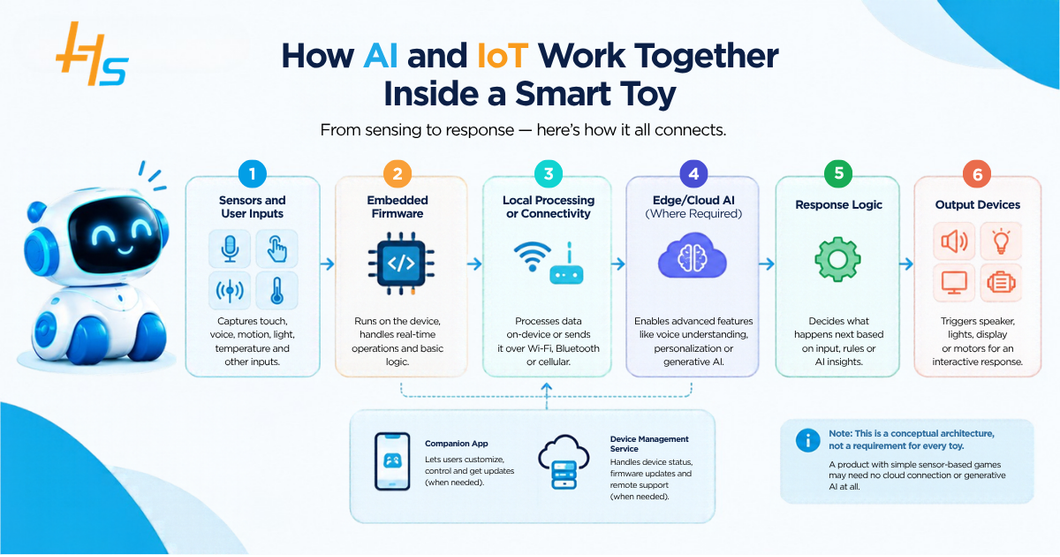
A companion app and device-management service may connect to the system when needed. This is a conceptual architecture, not a requirement for every toy. A product with simple sensor-based games may need no cloud connection or generative AI at all.
Key Ways AI and IoT Are Changing Interactive Toy Design
Voice-responsive and conversational play
Speech recognition allows a toy to identify spoken words or commands. Conversational AI can interpret more open-ended requests and generate responses based on the conversation.
For example, an illustrative storytelling toy could let a child choose a character and ask questions about the story. A conventional toy might offer several recorded choices, whereas an AI-enabled version could support a wider range of responses.
However, speech recognition can fail in noisy rooms, and generative AI can produce inaccurate or age-inappropriate answers. Designers should constrain the toy’s capabilities, test responses across realistic environments, and provide predictable alternatives when recognition fails.
Voice features also require careful decisions about microphone activation, recording, processing, retention, and parental consent.
Personalized educational experiences
AI can adapt activities based on a learner’s recent responses, selected difficulty, or progress through a defined set of exercises. An educational toy teaching numbers, for instance, could offer simpler questions after repeated errors and introduce more challenging tasks when a child demonstrates understanding.
IoT connectivity may help synchronize progress across supported devices or allow authorized adults to manage learning settings.
Personalization does not automatically improve educational outcomes. Poorly designed adaptation can reinforce mistakes, make activities too easy, or give misleading feedback. Product teams should define measurable learning objectives and evaluate them with appropriate users and educational expertise.
Where practical, a toy can perform basic adaptation locally without sending a child’s learning history to an external service.
Sensor-based physical interaction
Sensors enable toys to react to movement, touch, orientation, distance, or other measurable events. A robotics kit might use an accelerometer to detect tilting, while an interactive plush toy could respond to a squeeze or touch sensor.
AI may help interpret more complex sensor patterns, but simple thresholds and predefined rules are often more efficient for straightforward interactions.
The design challenge is matching the sensor to the intended behavior. A sensor that produces noisy readings can trigger false responses, while an unnecessarily complex sensing system adds cost, power consumption, and testing requirements.
Adaptive storytelling and games
AI can support stories that change according to a child’s choices, interests, or progress. A connected toy may also receive additional story packs or game content after launch.
These features can extend a product’s variety, but they require boundaries. A toy should not rely on unrestricted generated content when the intended audience needs predictable, age-appropriate interactions.
Designers should establish approved themes, response constraints, fallback stories, and limits on personalization. They should also test repeated interactions to identify contradictory storylines, inappropriate responses, and behavior that may confuse young users.
Connected applications and remote updates
Connected toy technology can support companion applications, configuration changes, content downloads, and software maintenance.
For manufacturers, remote updates can provide a way to correct certain software defects or improve supported features without physically replacing every device. However, updates can fail because of interrupted connectivity, insufficient storage, low battery levels, or incompatible firmware.
Products therefore need secure update mechanisms, compatibility checks, and recovery procedures. Manufacturers should also plan how long devices and their online services will be supported, particularly when core play features depend on external infrastructure.
Real-World Applications of IoT-Enabled Smart Toys
The following examples are illustrative product concepts, not claims about specific commercial deployments.
Educational toys and STEM kits
A connected STEM kit could combine physical components with sensors and an application that explains how a child’s construction behaves. AI might interpret selected questions or offer hints when a learner encounters a problem.
The main benefit is the opportunity to connect hands-on experimentation with responsive guidance. The product still needs accurate instructions, reliable sensor readings, and learning activities suited to its intended age group.
Robotic pets and interactive plush toys
A robotic pet could respond to movement, touch, voice commands, or predefined routines. AI may help interpret selected interactions, while embedded firmware controls motors, lights, and sound effects.
Connected features could allow adults to configure play modes or install additional content. Designers must account for mechanical durability, accessible moving parts, battery safety, and predictable behavior. A simpler offline interaction may be preferable for basic companionship features.
Smart storytelling devices
An interactive storytelling device could combine physical controls, audio playback, and optional AI-based question answering. Children might select a story, choose a character, or ask a supported question about an event in the narrative.
The product can provide a more flexible experience than a fixed audio player, but the team must control content quality and minimize unnecessary collection of voice data. Local story playback is also useful when internet access is unavailable.
Connected puzzles and creative-learning products
A puzzle or building toy could use sensors to recognize completed steps and provide contextual feedback. A companion app might present optional challenges or help adults manage difficulty levels.
AI is useful only if it adds meaningful interpretation or adaptation. If a simple sensor can reliably recognize the completed action, adding a remote model may increase cost and complexity without improving the experience.
Across these applications, the design principle remains the same: choose technology according to the interaction the product needs to deliver.
Technical Challenges Businesses Must Address
Battery consumption and power management
Microphones, wireless radios, displays, motors, and AI processors all draw power. Their combined consumption can affect battery life, device temperature, weight, and charging frequency.
Teams can reduce unnecessary consumption by using sleep modes, activating sensors only when needed, batching non-urgent network requests, and selecting efficient models. They should measure actual power consumption during representative play sessions rather than relying solely on component specifications.
Battery design must also account for charging behavior, protection circuitry, enclosure requirements, and applicable product-safety standards.
Voice latency and unreliable connectivity
A cloud-based conversation may involve audio capture, transmission, speech recognition, AI inference, response generation, and audio playback. Delays at any stage can make the interaction feel unresponsive.
Designers can reduce perceived latency by using local wake-word detection, short requests, efficient network protocols, and brief acknowledgment sounds where appropriate. These measures need testing on realistic networks and hardware.
The product should also define what happens when the internet is unavailable. Local games, prerecorded responses, and accessible physical controls can preserve basic functionality without a live AI connection.
Hardware costs and physical constraints
Every additional sensor, processor, radio, microphone, and power component affects the bill of materials, board layout, enclosure design, assembly, and quality assurance.
The team should distinguish features that directly support the core experience from optional features that introduce complexity. A low-cost educational toy may benefit more from reliable sensors and carefully designed firmware than from a large language model.
Hardware selection should consider availability, lifecycle support, memory requirements, power use, manufacturing tolerances, and the intended production volume.
AI response quality and age-appropriate content
AI systems can misunderstand questions, produce incorrect explanations, or generate responses outside the intended topic. These risks are particularly important in products designed for children.
Teams should define permitted topics, response length, age-appropriate language, escalation behavior, and fallback responses. They should test ambiguous inputs, repeated questions, background noise, and attempts to bypass content restrictions.
Content filtering alone is not a guarantee of safety. Product teams need layered controls, ongoing evaluation, incident-handling procedures, and clear expectations about the toy’s limitations.
Data security and children’s privacy
Connected toys may process voice recordings, account information, usage events, or information linked to a child. The exact risks depend on the features and data flows.
Privacy should be addressed during architecture design rather than added after implementation. Practical controls include:
- Collecting only the information needed for a defined function.
- Processing data locally when feasible.
- Encrypting data in transit and protecting stored information.
- Using secure device authentication and access controls.
- Providing understandable parental controls and consent mechanisms.
- Defining retention periods and deletion procedures.
- Securing firmware updates and maintaining a vulnerability-response process.
For products covered by the US Children’s Online Privacy Protection Act (COPPA), relevant requirements may include verifiable parental consent, notice, data minimization, security, and retention or deletion obligations. Applicability depends on the service, audience, data practices, and legal context.
Businesses selling into multiple markets should assess the applicable privacy, cybersecurity, radio, battery, and toy-safety requirements for each destination. For US toy products, the Consumer Product Safety Commission’s toy-safety guidance is a useful starting point.
Device reliability and long-term maintenance
Connected products introduce dependencies beyond the physical toy. Cloud services can change, mobile operating systems can evolve, certificates can expire, and third-party APIs can become unavailable.
A product’s maintenance plan should cover firmware updates, application compatibility, security fixes, service monitoring, spare parts where relevant, and end-of-support arrangements. Essential play functions should remain available for as long as reasonably possible without requiring a service that may eventually be discontinued.
What Businesses Should Consider Before Developing an AI-Powered Interactive Toy
Define the play objective and target age
Start with a specific user need. Is the toy intended to teach a concept, encourage physical activity, support storytelling, or provide responsive play?
The target age group affects the interface, physical construction, language, supervision requirements, privacy controls, and testing process. A concept intended for preschool children may require simpler interactions and stronger safeguards than one designed for older children.
Write down the intended behavior and how success will be evaluated before choosing the technology stack.
Select the simplest suitable AI and connectivity architecture
Compare the expected experience against the requirements of local processing, cloud services, Bluetooth, Wi-Fi, and offline operation.
| Design consideration | Local or edge processing | Cloud processing |
| Internet dependence | Can support selected offline functions | Usually requires a network connection |
| Response time | Avoids network round trips for local tasks | Depends on connectivity and service response |
| Compute constraints | Limited by the toy’s processor and memory | Can access more powerful remote models |
| Data handling | Can keep supported processing on-device | Requires careful transmission, storage, and access controls |
| Ongoing costs | Hardware and local software optimization | May include recurring inference, hosting, and connectivity costs |
A hybrid approach may be appropriate when immediate responses must work offline, but more complex interactions benefit from cloud processing. The choice should follow measured performance, privacy requirements, cost projections, and the expected lifetime of the product.
Validate the prototype before manufacturing
A prototype should test more than whether the electronics switch on. It should establish whether the interaction works reliably, whether children can understand it, whether the hardware survives expected use, and whether the complete system meets its power and safety requirements.
A practical validation plan can include:
- Interaction testing: Check recognition accuracy, response consistency, physical controls, and usability.
- Performance testing: Measure latency, battery life, thermal behavior, and connectivity recovery.
- Privacy and security testing: Review data flows, access controls, update mechanisms, and failure cases.
- Child-centered evaluation: Use appropriate research methods, informed permissions, and safeguards for any testing involving children.
- Manufacturing readiness: Assess component availability, assembly, quality control, enclosure durability, and applicable compliance testing.
A successful demonstration does not automatically establish production readiness. Realistic testing helps uncover problems that are difficult to identify from a concept model alone.
How HashStudioz Supports AI and IoT Toy Development
Developing an interactive toy requires coordination between physical hardware, embedded software, AI behavior, connectivity, and the application experience. Businesses evaluating these components can explore AI & IoT Toy Development services from HashStudioz to understand the available development support for connected toy concepts.
Depending on the project’s requirements and the capabilities confirmed for the engagement, relevant engineering work may include PCB and hardware design, embedded firmware, sensor integration, voice or AI features, IoT connectivity, cloud services, companion applications, and prototype preparation.
The business value lies in evaluating these components as one product rather than treating them as unrelated tasks. For example, the selection of an AI model affects processing requirements, which influence hardware cost and battery consumption. Connectivity decisions influence offline behavior and privacy. Companion application requirements affect device provisioning, permissions, and ongoing maintenance.
Toy manufacturers, startups, and EdTech companies should establish their intended user experience, target market, constraints, and technical requirements before finalizing a development plan.
If you are evaluating an interactive toy concept, discuss the product requirements, desired features, and development constraints with the HashStudioz team to determine an appropriate technical approach.
Conclusion
AI and IoT can make interactive toys more responsive, adaptable, and capable of receiving new content after launch. Their value depends on how well the technology supports the intended play experience, not on how many features a product contains.
Businesses should begin with the user need, select the simplest suitable combination of sensors, embedded software, connectivity, and AI, and test it under realistic conditions. Privacy, age-appropriate behavior, offline functionality, reliability, and product safety should guide design decisions from the beginning.
A well-designed interactive toy is one that performs its intended function consistently, protects its users, and remains useful throughout its supported product lifecycle.
Frequently Asked Questions
1. How do AI and IoT work together in interactive toys?
AI interprets inputs or adapts responses, while IoT enables communication between the toy, compatible devices, applications, and cloud services. A toy can use both technologies for connected conversational play, although neither cloud connectivity nor AI is necessary for every interactive feature.
2. What technologies are used in AI-powered interactive toys?
Depending on the product, the technology stack may include microphones, touch or motion sensors, embedded processors, firmware, Bluetooth or Wi-Fi, speech recognition, machine learning models, cloud services, and companion applications. The required components depend on the intended interaction, budget, power constraints, and privacy requirements.
3. Can IoT-enabled smart toys work without an internet connection?
Yes, if the product is designed for offline operation. Local firmware, sensors, prerecorded audio, and on-device AI can support selected functions without internet access. Features that depend on remote AI models, cloud content, or online accounts may be unavailable when the connection fails.
4. How can developers protect children’s data in connected toys?
Developers should minimize data collection, process information locally where feasible, secure communications and stored data, provide suitable parental controls, and define retention and deletion procedures. They should also assess applicable child-privacy laws and test the product’s security throughout its supported lifecycle.
5. What should businesses consider before developing an AI-powered toy?
Businesses should define the target age group and play objective, determine whether AI adds meaningful value, select appropriate hardware and connectivity, estimate battery and operating costs, and plan privacy, security, safety, and maintenance from the outset. Prototype testing should validate the complete user experience before manufacturing decisions are finalized.