 +91-97185 17228
 +1 (408) 757 0570

- About Us
- Our Services
- Solution
- Products
- Hire
- Industries
- Resources
-
 PARTNER
- Contact Us
PARTNER




How HashStudioz rebuilt a ServiceNow cloud inventory connector with improved CMDB integration, OAuth 2.0 authentication, and a seamless zero-loss customer migration process.
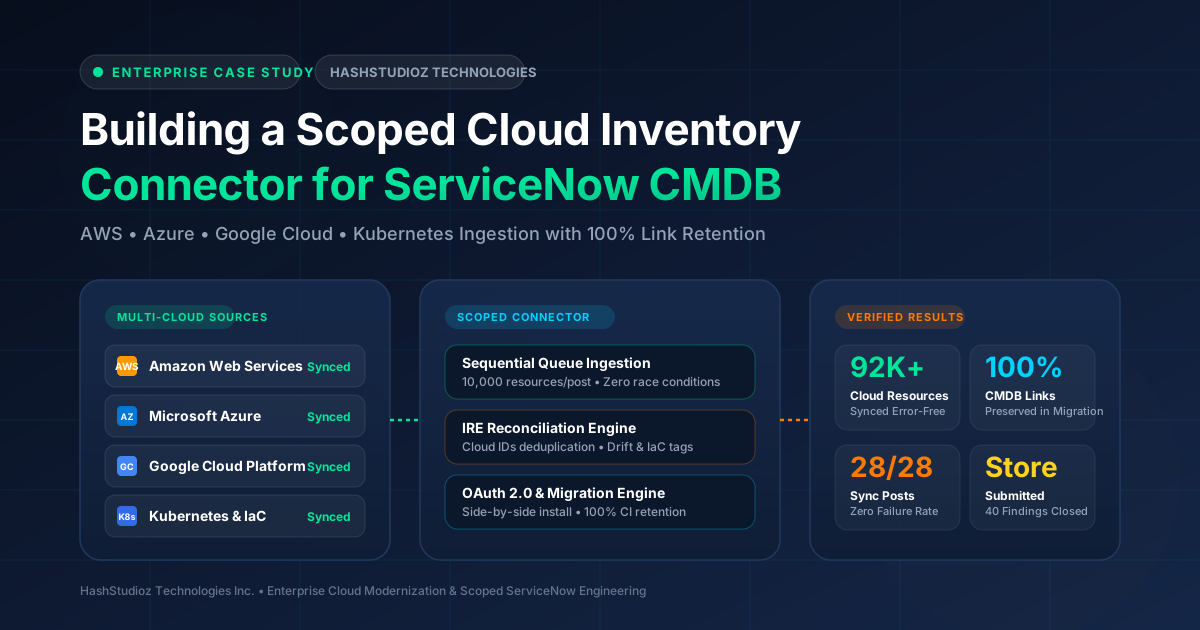
A cloud asset management company needed to bring its third-party built ServiceNow connector under its own publisher identity while upgrading its data model and maintaining continuity for existing enterprise customers. HashStudioz engineered a new scoped ServiceNow application featuring sequential batch queue processing, native Identification and Reconciliation Engine (IRE) mapping, and an automated tenant migration mechanism that successfully processed 92,000+ cloud resources across 28 posts with 0 errors while preserving 100% of established CMDB Configuration Item links.
Explore how multi-cloud infrastructure is ingested, visualized, and reconciled inside the client-owned ServiceNow scoped application.
| Batch ID | Account | Items | Status |
|---|---|---|---|
| #BATCH-028 | AWS-Prod-Core | 10,000 | 202 Ingested |
| #BATCH-027 | Azure-WestUS-Ent | 9,850 | 202 Ingested |
| #BATCH-026 | GCP-Analytics-EU | 8,400 | 202 Ingested |
| #BATCH-025 | K8s-Prod-Cluster | 6,730 | 202 Ingested |
Legacy Third-Party Store Application
Client Scoped Connector (x_clm_cloud_sync)
Matched on Canonical Cloud ID (AWS ARN)
ServiceNow IRE validates existing records, updates authorized attributes, and prevents redundant CI duplication.
Live resource diverged from Terraform repo
The connector flags unmanaged or drifted cloud resources directly on the CI record for SecOps and compliance teams.
Resource absent in cloud inventory scan
Rather than silently deleting records, missing CIs are marked 'Retired', protecting historical change tickets and audit logs.
Bringing the connector under the client’s own publisher identity while scaling synchronization reliability required solving several complex integration hurdles.
The existing ServiceNow Store application could not simply be renamed to reflect the client's publisher identity. A new scoped application had to be developed, with a seamless migration mechanism to help existing customers move from the old connector.
The connector needed to support the latest inventory API and capture richer cloud asset metadata within ServiceNow, including IaC status, configuration drift, monthly costs, and security policy findings.
The connector needed to process payloads of up to 10,000 resources reliably. Parallel requests from multi-region environments caused processing conflicts, race conditions, and read-limit timeouts on standard endpoints.
Multi-cloud resources needed to match their corresponding Configuration Items (CIs) in ServiceNow without producing duplicates or breaking existing business service relationships during migration.
Enterprise security demanded modern OAuth 2.0 client credentials authentication while maintaining password-based authentication side by side for backward compatibility with existing customer instances.
Architect a Store-certified scoped application, eliminate synchronization race conditions with sequential queuing, implement streamed data parsing, and ensure zero loss of existing CMDB relationships.
How HashStudioz transferred established cloud asset records to the new data model while preserving 100% of Configuration Item relationships. Click each step below to inspect the process.
The new scoped application is installed directly alongside the existing third-party connector. The new connector initializes its scoped tables without altering live production CMDB tables or disrupting scheduled sync jobs.
Rather than creating conflicting duplicate rules, the new application attaches itself dynamically to the existing identification rule owned by the legacy connector to ensure incoming records reference the existing CMDB schema.
An administrative migration page copies existing cloud asset records into the enriched new data model in manageable, monitored chunks (500–1000 items) with dry-run capabilities and full progress telemetry.
Established relationships between cloud assets and ServiceNow Configuration Items (CIs) are verified and preserved. Historical incident linkages, change management tickets, and operational mappings remain completely intact.
Once all assets are transferred and audited, the legacy third-party application package is cleanly deactivated and uninstalled. The customer instance retains all migrated data and Configuration Items.
The new scoped connector autonomously activates its own proprietary identification rules and initiates continuous background synchronization. Live inventory from AWS, Azure, GCP, and Kubernetes flows directly into the CMDB.
Legacy & Scoped Application Coexisting Safely
[10:14:02] sys_app: x_clm_cloud_sync v1.0.0 installed into scope.
[10:14:04] sys_scope: Verified isolation from legacy tables.
Attached to CMDB Identification Rule
[10:15:10] cmdb_identifier_rule: Attached to criterion sys_id=c48a192b0.
[10:15:12] ire_engine: Scoped identifier rules synchronized.
Porting Historical Cloud Assets to New Model
[10:16:30] GlideRecord stream: Batch 28/28 ported without table locks.
[10:16:45] SUCCESS: 92,000 cloud assets copied with 0 errors.
Zero Broken CI References Verified
[10:18:01] cmdb_rel_ci audit: Scanned 124,580 relational links.
[10:18:05] VERIFIED: 100% links preserved. 0 orphaned CIs.
Old Third-Party App Cleanly Deprecated
[10:19:22] sys_store_app: Legacy third-party package uninstalled.
[10:19:26] cmdb_identifier_rule: Restored scoped rules as canonical.
Multi-Cloud CIs Ingesting via OAuth 2.0
[10:20:00] Scheduled Job 'Cloud Ingestion Daemon' active (FIFO).
[10:20:05] HEALTHY: AWS, Azure, GCP, K8s streaming error-free.
The connector was architected as a modular scoped application following ServiceNow's best practices, organizing ingestion, CMDB reconciliation, and user controls into decoupled tiers.
REST APIs validate incoming inventory posts, cap record counts, and store raw payloads in a dedicated Sync Batch table. A background queue processor claims execution one batch at a time, ensuring concurrent multi-thousand resource deliveries never collide or cause database row locks.
The application leverages the ServiceNow Identification and Reconciliation Engine (IRE) to match incoming multi-cloud resources on canonical cloud identifiers (AWS ARNs, Azure IDs, GCP URIs). Auxiliary Cloud Asset records enrich CIs with IaC status, configuration drift, monthly costs, and security policy findings.
Native dashboards and reports show cloud assets grouped by provider, lifecycle status, policy findings, and synchronization history. A dedicated tenant migration page allows administrators to transfer existing customer records with live dry-run audits and chunked progress logs.
How inventory from AWS, Azure, Google Cloud, and Kubernetes is securely streamed, queued, deduplicated, and mapped to ServiceNow Configuration Items.
EC2, S3, RDS, Lambda, VPC, IAM
42,320 ResourcesVMs, Storage Blobs, AKS, VNets
28,140 ResourcesCompute Engine, GKE, BigQuery
15,228 ResourcesPods, Namespaces, Terraform State
6,730 ResourcesScoped Token Validation
Dual Auth ReadyOvercomes Payload Limits
Up to 10K / PostFIFO 1-at-a-Time Worker
0 Race ConditionsCanonical Cloud ID Match
0 Duplicate CIsIaC Drift, Cost, Tags & Policies
Enriched Telemetrycmdb_ci_cloud_resource & CIs
100% Links Retained
Engineered under the client's publisher namespace (x_clm_cloud_sync) and submitted to the ServiceNow Store. Trace the complete decoupled architecture from multi-cloud REST streaming to native IRE reconciliation and zero-loss customer migration.
High-volume payloads of up to 10,000 resources are deserialized through streamed reading and processed FIFO one batch at a time to eliminate database collisions.
Leverages ServiceNow's native Identification and Reconciliation Engine to match cloud identifiers (AWS ARNs, Azure IDs, GCP URIs) with zero duplicate records created.
Transfers existing tenant inventory into the new scoped schema while maintaining 100% of established CMDB relationships without manual intervention.
Engineered to meet the stringent security, architecture, and performance guidelines of the ServiceNow Store.
Bypassed platform JSON memory limits by implementing streamed data deserialization for high-volume payloads.
Eliminated database row-lock collisions by queueing sync batches and executing them one by one in the background.
Supports modern OAuth 2.0 client credentials while preserving basic password auth for existing customer environments.
Resources missing from incoming cloud inventory are marked 'Retired' rather than deleted, safeguarding downstream ITIL tickets.
| Application Scope | Custom Scoped Application |
| Tested Release Families | Utah, Vancouver, Washington DC |
| Batch Capacity | Up to 10,000 resources per post |
| Supported Clouds | AWS, Azure, Google Cloud, K8s |
| Reconciliation Engine | ServiceNow IRE (Native) |
| Authentication Types | OAuth 2.0 Client Credentials & Basic |
| Store Code Scans | 40 findings closed & resolved |
| Store Submission | Submitted for Certification |
What we found along the way: addressing real-world integration discrepancies on day one to guarantee 99.99% production stability.
The client's documentation described one payload format, but live production sync agents were sending an older version.
The first full-scale production run pushed a massive payload past ServiceNow's native JSON string memory buffer, causing timeouts.
Parallel inventory posts from multi-region cloud accounts raced each other on shared resources, causing database write locks.
The rebuilt scoped connector gave the client complete ownership over its integration roadmap, solved synchronization reliability, and provided an effortless migration path.
| Project Metric | Rebuilt HashStudioz Scoped Application |
|---|---|
| Full Inventory Sync | 92,000+ resources in 28 posts processed without errors |
| Resources per Post | Up to 10,000 resources with streamed memory reading |
| Tenant Migration | 100% of existing CMDB links preserved during live migration |
| Processing Concurrency | Sequential queue: Zero parallel race conditions |
| Authentication | Dual-mode: OAuth 2.0 client credentials & password auth |
| App Ownership | Published under the client's own ServiceNow publisher account |
"Working with you was great. You are on top of things, pushed forward."
We combine ServiceNow application development and high-throughput integration engineering to build store-grade enterprise solutions.
Tables, scripted REST APIs, identification rules, dashboards, access control (ACLs), and Store packaging built strictly within platform governance rules.
We analyze production traffic patterns before designing receivers, and we rigorously test with production-sized data rather than superficial samples.
Rebuilding under the client's own publisher identity with an automated migration path for existing customers, avoiding high-risk manual database renames.
End-to-end preparation including platform application scans, Store certification self-tests, code reviews, and user documentation delivery.
Common architectural questions on multi-cloud inventory synchronization and ServiceNow CMDB integration.
A SaaS vendor who wants a certified ServiceNow connector for your product? An enterprise that needs its cloud estate in the CMDB? We deliver the whole path: connector architecture, CMDB reconciliation, OAuth security review, and Store certification.
Our integration architects can help you evaluate technical feasibility, CMDB IRE reconciliation rules, and Store certification steps.
Schedule a Technical Consultation Browse All Technical Case Studies



Office No. 902, 9th Floor, Pegasus Tower, A-10, Block A, Sector 68, Noida, Uttar Pradesh 201301

161 W Altadena Dr, Unit 501 STE Altadena, CA 91001-4735

C-205, SM Heights, 3rd Floor, Sector 74, Industrial Area Phase 8B 160055, Mohali

Plot No. 45B, Doon IT Park, Sahastradhara Road, Dehradun, Uttarakhand 248013, India

No 207, A Block, 306, Raheja Towers, Anna Salai, Chennai 600002

273, Sector 8, Imt Manesar, Gurugram, Haryana 122051
